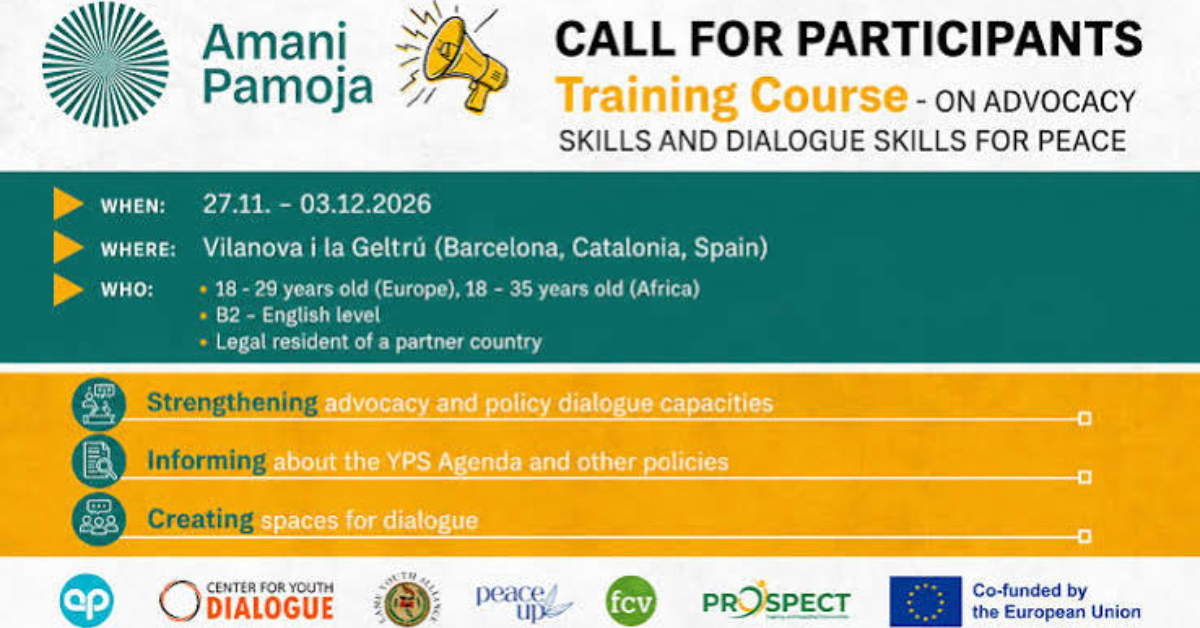
The Amani Pamoja Training Course 2026 in Spain is inviting young people active in peacebuilding to develop advocacy and dialogue skills. Supported by the Erasmus+ Programme of the European Commission, the training will take place in Vilanova i la Geltrú, Barcelona, from 27 November to 3 December 2026, including travel days.
The Amani Pamoja Training Course 2026 offers young people involved in peacebuilding an opportunity to strengthen their knowledge and practical skills in peace advocacy and dialogue. The programme focuses particularly on young people who are active in peacebuilding work and interested in developing their advocacy competencies.
The in-person training will take place in Vilanova i la Geltrú, Barcelona, Catalonia, Spain, from 27 November to 3 December 2026, including travel days. The programme is supported by the Erasmus+ Programme of the European Commission.
Applicants are required to complete an online application form and provide information about their personal background, organisation, peacebuilding experience, motivation and availability.
Background & Training Course Description
The Amani Pamoja course is focused on Advocacy and Dialogue Skills for Peace. It is designed for young people who are already active in peacebuilding or who have an interest in strengthening their ability to advocate for peace.
The application form specifically asks applicants to demonstrate their experience in Youth, Peace and Security, including examples of projects or initiatives they have personally worked on.
Applicants are also asked to describe their organisation’s experience in Youth, Peace and Security and provide examples of peace advocacy practices adopted by themselves and their organisations.
This indicates that the programme is looking for participants who can connect the training with existing peacebuilding activities and potentially apply the knowledge gained after the course.
Training Location and Dates
The main training will be held in:
Vilanova i la Geltrú, Barcelona, Catalonia, Spain
The stated dates are:
27 November – 3 December 2026
The dates include travel days.
Applicants must also be available for preparatory activities before the main training. According to the application form, there will be three online preparatory meetings in October and November, with each meeting lasting no more than two hours.
Participants are also expected to attend the full in-person component of the course.
Who Should Apply?
The application form states that organisers are selecting young people active in peacebuilding work who are interested in developing advocacy competencies.
Applicants are asked to provide information about their involvement with an NGO or organisation, including:
- Their role within the organisation
- Organisation name
- Reference person and email address
- Organisation website
- Experience in Youth, Peace and Security
- Organisational experience in peace advocacy
Applicants may also describe involvement in community groups, clubs or other youth organisations working for peace.
The application does not indicate that applicants must have previously completed advocacy training. In fact, candidates are asked whether they have participated in advocacy training before and, if so, to provide the title and institution that delivered it.
Application Requirements
Applicants should be prepared to provide detailed information throughout the online application.
The personal information section requests:
- Applicant’s name
- Surname
- Email address
- Phone number
- Date of birth
- City of residence
- Gender
- Role in the organisation
- Organisation name
- Reference person’s details
- NGO website
- English language level
Applicants can select an English level from A1, A2, B1, B2, C1 or C2.
A CV in PDF format is also required. The application form states that the uploaded PDF must not exceed 10 MB.
Motivation and Peacebuilding Experience
A significant part of the application focuses on the applicant’s motivation and previous experience.
Applicants must explain what inspired them to apply for the Peace Advocacy Course in 150–200 words.
They must also describe their personal experience in Youth, Peace and Security in 150–250 words, including at least one project or initiative they have worked on. The form allows applicants to provide a link where relevant.
Another question asks applicants to explain their organisation’s experience in Youth, Peace and Security and provide an example of a project or initiative the organisation has worked on.
Candidates are also asked to describe at least one peace advocacy practice or experience they have personally adopted and another practice or experience their organisation has adopted.
These questions make it important for applicants to provide concrete examples rather than simply stating that they are interested in peacebuilding.
What Applicants Hope to Gain
The application asks candidates to briefly explain what they hope to gain from the course.
Applicants may therefore wish to clearly connect their learning objectives with their existing peacebuilding work, advocacy activities and future plans.
The form also asks whether applicants would commit to applying what they learn through an advocacy initiative after the training. Candidates answering yes are required to explain how they intend to do this.
Applicants are additionally asked whether they would be interested in participating in other project activities as a facilitator.
Barriers to Participation
The application includes questions designed to understand barriers that may affect participation in peace initiatives.
Applicants can identify barriers including:
- Social barriers
- Economic barriers
- Disability-related accessibility barriers
- Health-related accessibility needs
- Barriers to education and training
- Discrimination or cultural differences
- Geographical barriers
- Distance or mobility-related challenges
Candidates who select relevant barriers are asked to provide a short description explaining how those barriers affect them.
The form also asks whether applicants have health or dietary needs that organisers should know about, including allergies, vaccination-related information, medical management or special dietary requirements.
Applicants should provide accurate information where relevant so that organisers can understand any participation or accessibility requirements.
Travel and Participation Requirements
Applicants are asked whether they have a valid passport and whether they are legally resident in one of the six participating countries.
They must also confirm whether they can attend both the online and in-person meetings for the full duration of the course.
The application states that participants should be able to attend the three preparatory online meetings as well as the full in-person five-day component.
A follow-up online meeting is also planned after the activity, and applicants are asked whether they will be available to participate.
Sharing the Experience After the Training
The programme places importance on participants sharing their experience with their organisations and communities after the activity.
Applicants are asked whether they plan to share what they learn and, if they answer yes, how they intend to do so.
Candidates are also asked whether they have creative skills that could support peace advocacy. Examples given in the form include:
- Writing
- Art
- Music
- Video creation
- Social media design
These skills may provide participants with additional ways to communicate peacebuilding messages and engage their communities.
Why Peace Advocacy Matters for Young People
The application specifically asks candidates to explain how they believe peace advocacy is relevant today for young people.
This question gives applicants an opportunity to demonstrate their understanding of the role young people can play in peacebuilding and advocacy.
Rather than providing a general statement, applicants should consider connecting their answer to their own community, organisation or peacebuilding experience.
The strongest responses are likely to demonstrate a clear understanding of why advocacy and dialogue skills can help young people participate more effectively in peace initiatives.
How to Apply
Interested candidates should complete the online application form for the Amani Pamoja Training Course and provide the requested information.
Applicants should prepare their CV in PDF format, with the application form stating a maximum file size of 10 MB.
The application includes questions covering personal information, organisational involvement, motivation, Youth, Peace and Security experience, advocacy experience, English proficiency, accessibility considerations, travel documents and availability.
Candidates should carefully answer the questions within the specified word limits where word counts are provided.
Important Details
Programme: Amani Pamoja Training Course
Focus: Advocacy and Dialogue Skills for Peace
Dates: 27 November – 3 December 2026
Location: Vilanova i la Geltrú, Barcelona, Catalonia, Spain
Support: Erasmus+ Programme of the European Commission
Target participants: Young people active in peacebuilding
Main focus: Peace advocacy, dialogue, Youth, Peace and Security
Preparatory meetings: Three online meetings during October and November
Main activity: In-person training
CV: Required in PDF format, maximum 10 MB
Application: Online application form
Final Thoughts
The Amani Pamoja Training Course 2026 is aimed at young people who are already involved in peacebuilding or are interested in developing practical advocacy competencies. The programme combines online preparation with an in-person training experience in Spain focused on advocacy and dialogue skills for peace.
Applicants should pay particular attention to the questions concerning Youth, Peace and Security, personal peacebuilding experience, organisational activities, advocacy practices and motivation. The application also requires candidates to demonstrate their availability for preparatory meetings, the full in-person programme and a later follow-up activity.
Those interested in applying should review the complete application form carefully, prepare their CV and provide specific examples of their peacebuilding and advocacy experience.
SEO Keywords: Amani Pamoja Training Course 2026, Amani Pamoja 2026, peace advocacy training 2026, dialogue skills for peace, Erasmus Plus training course 2026, Erasmus+ youth opportunities 2026, peacebuilding training in Spain, youth peacebuilding opportunities, Youth Peace and Security training, peace advocacy opportunities 2026, international youth training 2026, fully supported Erasmus+ training, youth exchange Spain 2026, peacebuilding opportunities for young people, advocacy skills training, dialogue training for youth, youth peace and security opportunities, Erasmus+ opportunities Spain, international peacebuilding programmes, youth leadership and peacebuilding
For more opportunities like these, be sure to follow us on Facebook, join our WhatsApp Group and Channel
Related Opportunities on Reign Gigs
- WHO Opens International Health Training Programme for Future Public Health Professionals
- Harvard Cybersecurity Courses 2026: Free and Executive Online Programs to Advance Your Cybersecurity Skills
- Nestlé Internship 2026: Global Internship Opportunities Now Open for Students and Graduates
- Procope Programme 2026–2027: DAAD-Funded Germany–France Research Exchange for Scientists Across All Disciplines
